
WhatsApp Bulk Message Daily Limit: How Many Messages Can You Send Without a Ban?
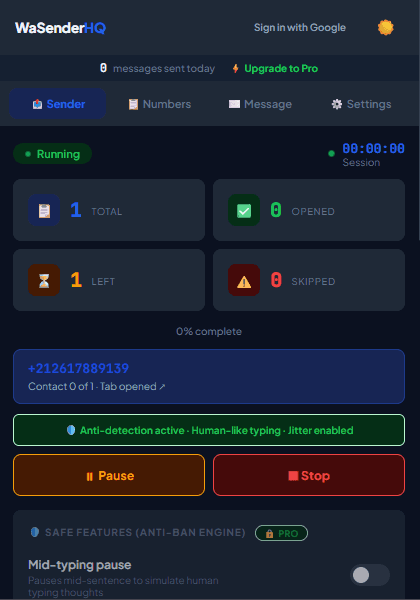
One of the most frequently asked questions in WhatsApp marketing is: “How many WhatsApp messages can I send per day before my number gets banned?”
The short answer is that WhatsApp does not publish a single, rigid numerical cap for WhatsApp Web sessions. Instead, WhatsApp employs automated behavioral machine learning systems that evaluate account age, contact reputation, recipient blocking rates, and sending velocity. Sending 500 identical messages in 5 minutes from a 3-day-old SIM card will trigger an immediate suspension, while an established business number sending 250 personalized messages spaced across an entire working day with randomized delays can operate safely for years.
The Reality of WhatsApp Limits by Account Type
Understanding which platform tier your number operates on defines your baseline capacity:
- Personal WhatsApp App: Intended for 1-to-1 interpersonal chats. Highly sensitive to sudden volume spikes. Safe volume for reviewed outreach is typically 20 to 50 messages per day after warm-up.
- WhatsApp Business App: Designed for local business customer service. Has greater tolerance for customer outreach, comfortably handling 50 to 150 daily broadcast conversations when contacts expect them.
- Browser Automation (WhatsApp Web): When using supervised extensions like WaSenderHQ, messages are dispatched through your active desktop browser session. Safety depends directly on your delay intervals and recipient consent.
- Official WhatsApp Cloud API: Governed by Meta's formal messaging tiers (Tier 1: 1,000 conversations/day, Tier 2: 10,000/day, Tier 3: 100,000/day). Requires template approval, Meta verification, and per-conversation fees.
The 4-Week Account Warm-Up Schedule
If you are registering a new phone number or starting campaigns for the first time, you must warm up the number gradually to build platform trust:
- Week 1 (Days 1–7): 10 to 20 messages per day. Send only to established contacts or active inbound queries who reply immediately. Two-way dialogue is the single strongest positive reputation signal.
- Week 2 (Days 8–14): 25 to 50 messages per day. Introduce randomized delays of 15 to 45 seconds between messages. Always personalize messages with customer names.
- Week 3 (Days 15–21): 50 to 100 messages per day. Divide campaigns into morning and afternoon batches rather than sending in one continuous burst.
- Week 4+ (Ongoing): 100 to 250 messages per day for established accounts. Keep your Do Not Message suppression list updated and immediately honor any opt-out request.
Top 3 Triggers for WhatsApp Account Restrictions
WhatsApp automated security looks primarily at recipient reactions and unnatural mechanical patterns:
- High User Block / Report Rate: When recipients click “Block & Report Spam”, WhatsApp flags the sender immediately. Even 3 to 5 reports in a single day can trigger a temporary restriction. Always include a polite opt-out option (e.g. “Reply STOP if you prefer not to receive updates”).
- Zero Jitter / Mechanical Velocity: Sending messages at an exact fixed interval (e.g., precisely every 2.0 seconds) reveals automated bot patterns. Use WaSenderHQ's smart randomized jitter delay to mimic human pauses.
- Identical Message Content: Broadcasting identical copy to hundreds of numbers flags duplicate hash checks. Use Spintax variation (e.g.
{Hi|Hello|Good day}) and personalized spreadsheet tags like{Name}and{OrderNumber}.
Summary: Safe Sending Rules to Remember
Automation should make a supervised process repeatable, not replace human judgment. Use vetted, opt-in contact lists, test small samples first, verify international formatting, and maintain measured delay pacing.
Practical workflow
Managing your WhatsApp sending volume is about building long-term account reputation rather than hunting for an arbitrary hack. Follow a gradual warm-up schedule, introduce natural random delays, and strictly respect user consent.
- 1
Establish an account warm-up routine
For new numbers or recently linked WhatsApp sessions, start conservatively with 10 to 20 messages per day to contacts who will reply. Increase batch sizes gradually over 3 to 4 weeks.
- 2
Configure randomized jitter intervals
Never send messages at rigid, identical intervals. Set WaSenderHQ delay bounds (e.g. 15 to 45 seconds) with random jitter to mimic human conversational rhythm.
- 3
Personalize every message with tags
Use placeholders like {Name}, {OrderNumber}, and Spintax variations {Hi|Hello|Good day} so that no two consecutive messages are byte-for-byte identical.
- 4
Active suppression management
Maintain a synchronized local Do Not Message list. Immediately suppress any recipient who asks to opt out or replies negatively.
- 5
Monitor recipient reaction signals
Pause campaigns immediately if your failure rate rises or if contacts indicate surprise at receiving the message. Human supervision protects your number.
Pre-send checklist
- Account has been active for more than 30 days
- Randomized delay interval configured (15-45s)
- Spintax and personalized tags inserted
- Suppression list updated before starting
- Daily batch kept within current warm-up tier
- Sender identity clearly stated in first sentence
Common mistakes to avoid
Broadcasting to thousands on day one
Sending large bulk volumes from an un-warmed or brand-new number triggers instant automated spam restriction algorithms.
Using scraped or purchased phone databases
Recipients who did not opt in will report your account as spam. Just 3 to 5 reports in a 24-hour period can lead to account suspension.
Ignoring recipient opt-out requests
Failing to honor opt-out replies guarantees spam reports on your subsequent campaigns. Always suppress immediately.
Measure and improve the workflow
Define the stop conditions first
Before starting, decide who will supervise the queue and when it must pause: unexpected formatting, a disconnected WhatsApp Web session, a rising failure count, or recipient feedback that the message was not expected. Automation should make a reviewed process repeatable, not remove human judgment.
Measure the workflow, not a vanity number
Track sent, skipped, and failed entries together with pauses, corrections, replies, and opt-out requests. A large sent count does not prove delivery, relevance, or business value. The useful question is whether the intended service task was completed without creating avoidable recipient complaints.
Review access after testing
Check browser permissions, Google access, local drafts, saved schedules, and downloaded activity files after the campaign. Revoke access that is no longer required and remove outdated queues so a future user cannot restart an old campaign by mistake.
Keep a manual recovery path
Document how to stop the queue, reconnect WhatsApp Web, verify the current row, and continue only after the sender understands what happened. If behavior is unexpected, preserve the log and test with your own number rather than repeatedly retrying a real customer.
Frequently asked questions
Is there an official daily limit for WhatsApp Web?
WhatsApp does not publish a rigid numerical limit for Web sessions. Safety depends on your account age, sending speed, delay jitter, and recipient report rate.
How many messages can a brand new SIM card send?
New SIM cards should strictly stay below 10 to 25 messages per day during week one, with heavy emphasis on receiving replies from existing contacts.
Does WaSenderHQ enforce an arbitrary daily cap?
WaSenderHQ Pro does not impose artificial software caps, but provides built-in pacing controls and warm-up tools so you can run safe, supervised campaigns.
What should I do if my number is restricted?
Use the official in-app WhatsApp appeal option. State that you operate a legitimate business customer communication channel with user consent.
Sources and further reading
About the author
The WaSenderHQ Editorial Team documents workflows against the current public extension listing and product source, with a focus on accurate setup, privacy, and responsible use. Articles are revised when product behavior changes.